
“Domestic violence is not a private matter; it is a public concern and a human rights issue”1
Now that the three-year EU project VIPROM has come to an end, we as VIPROM coordinating team reflected on what has been achieved and whether our ambitious goals have been met. Has our project opened new windows of opportunity to support victims of domestic violence more effectively? Has it been successful?
But how do you measure success in a project like VIPROM? While it is impossible to quantify how many victims have been identified or supported as a direct result, success can be assessed by whether our goals were achieved and whether the tools and materials developed are recognised and used in practice. In this sense, VIPROM has grown from an ambitious European initiative into a collaborative success story that has strengthened the medical sector’s response to domestic violence across Europe.
What did VIPROM promise?
- To raise awareness throughout Europe on Domestic violence (DV)
- To develop a European training platform with training materials tailored to the medical sector
- To design a VIPROM stakeholder tailored curriculum and related training concepts based on needs assessment
- To develop a VIPROM train-the trainer programme (TtT)
VIPROM ON TOUR: STRONG PRESENCE ACROSS EUROPE
✔ We have successfully raised awareness on DV in Europe
We introduced VIPROM to partner countries nationally and internationally. We organised workshops and seminars and delivered talks and training sessions for medical stakeholders. In addition, we held a European webinar series with over 2,000 participants from 24 countries, gave interviews, shared information on domestic violence, and discussed the role of the medical sector in podcasts.
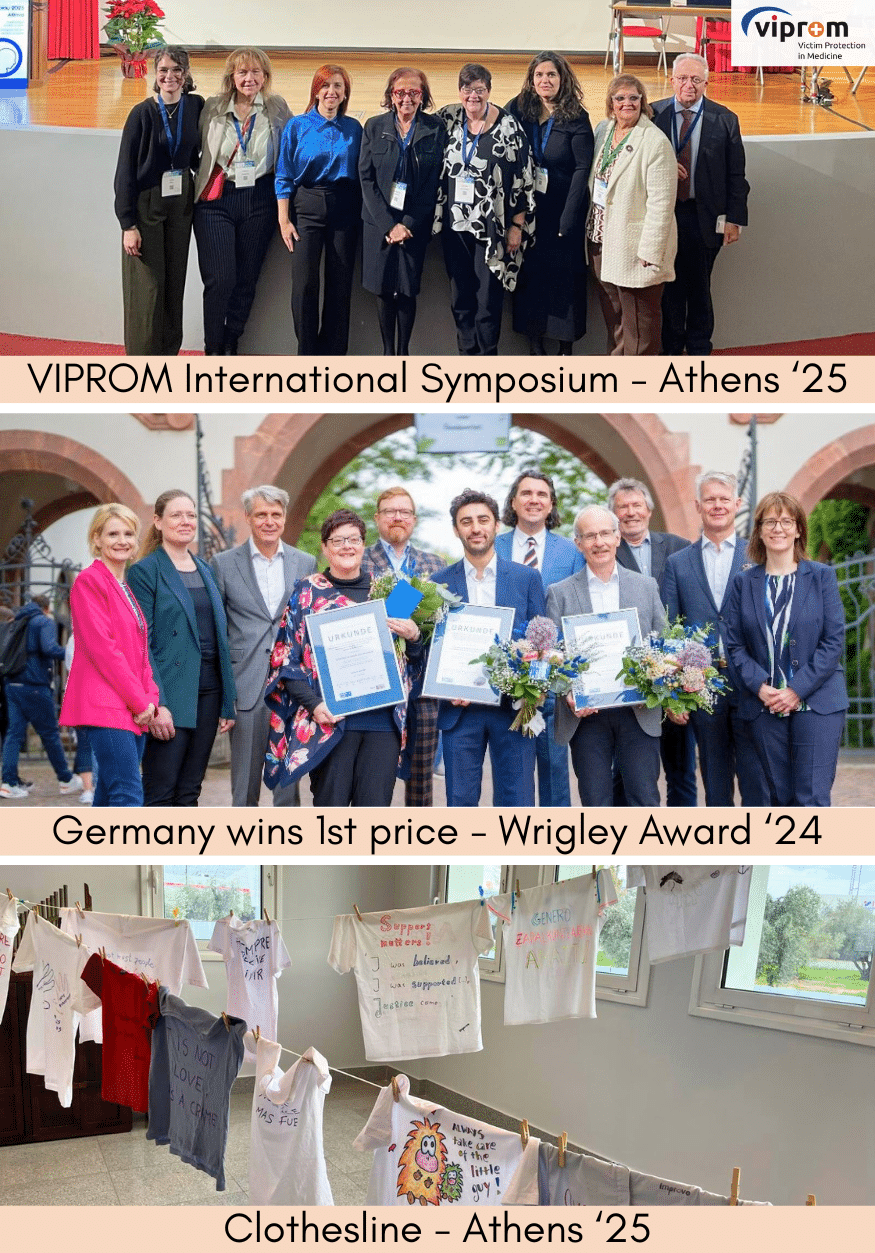
One of the highlights was the German VIPROM team winning first prize in the “Medical Practice and Society” category of the 2024 Wrigley Award, in recognition of the project’s innovative contribution to the development of training materials for dentists, with the slogan “Dentists see more than teeth!”
We also published five newsletters and eighteen blog posts, covering a variety of topics related to domestic violence, prevention and medical practice. VIPROM also created opportunities for raising awareness and advocacy. The Clothesline Exhibitions in Münster (November 2024) and Athens (December 2025) amplified the voices of domestic violence survivors powerfully, fostering reflection, empathy and public dialogue.
VIPROM AS AN INNOVATIVE KNOWLEDGE HUB
✔ We developed successfully a European training platform with training materials tailored to the medical sector
The project’s main achievement is the European Training Platform on Domestic Violence, available in six languages. The platform includes ten comprehensive modules, multilingual access, and national adaptations. It serves as a flexible resource for trainers, complementing rather than replacing face-to-face learning. For a medical student encountering the topic of domestic violence for the first time, or a practising physician seeking concrete guidance for a difficult conversation, the platform offers practical, accessible support that can be applied directly in clinical settings.
Moreover, VIPROM has produced a range of high-quality publications designed to support healthcare professionals in their work, such as:
- Guidelines for Changemakers in Domestic Violence Prevention & Response, which offers a multidisciplinary framework and practical strategies.
- Roadmap for Victim Protection in Medicine and Domestic Violence: Informed Medical Care, a practical guide to implementing domestic violence training in medical institutions.
- Nine public deliverables covering topics such as stakeholder needs assessments, curriculum development and evaluation.
VIPROM AS A SUSTAINABLE TRAINING HUB
✔ We designed a VIPROM stakeholder tailored curriculum and related training concepts based on needs assessment
We developed a high-quality set of training materials and educational resources tailored specifically to the medical sector. These resources were designed to be practical, evidence-based, and easy to integrate into everyday teaching and clinical contexts. A few of those tools are highlighted in short.
VIPROM Med.DocCard© and Dent.DocCard©
The VIPROM Med.DocCard© and Dent.DocCard© are concise, practice-oriented tools developed for medical and dental professionals. They provide essential guidance on how to recognise signs of domestic violence, respond appropriately, and refer patients to specialised support services. These tools are already in use in medical and dental practice. For a dentist for example noticing unexplained injuries during a routine examination, or a physician unsure how to raise concerns safely, these tools help turn awareness into informed support for victims.
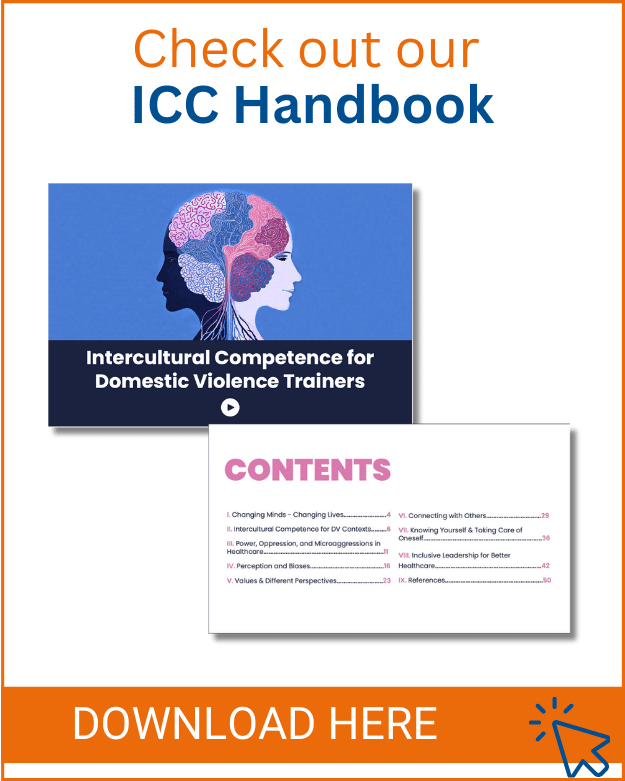
ICC VIPROM Handbook: Intercultural Competence for Domestic Violence Trainers
The ICC VIPROM Handbook: Intercultural Competence for Domestic Violence Trainers addresses a critical dimension of domestic violence training: intercultural sensitivity and inclusivity. Developed as a practical resource, the handbook supports trainers in reflecting on cultural diversity, power dynamics, and structural inequalities that shape experiences of violence and access to support.
Training Videos and Repository
In addition, VIPROM developed a collection of training videos covering key aspects of domestic violence for dentistry (available in English an German). These videos provide engaging, scenario-based learning and interviews with experts, helping trainers and professionals visualise best practices. To complement these materials, VIPROM established a repository of existing training materials from all partner countries, making national resources accessible at the European level. This repository allows trainers to explore, compare, and integrate diverse approaches, fostering a truly European perspective on domestic violence prevention and response in healthcare.
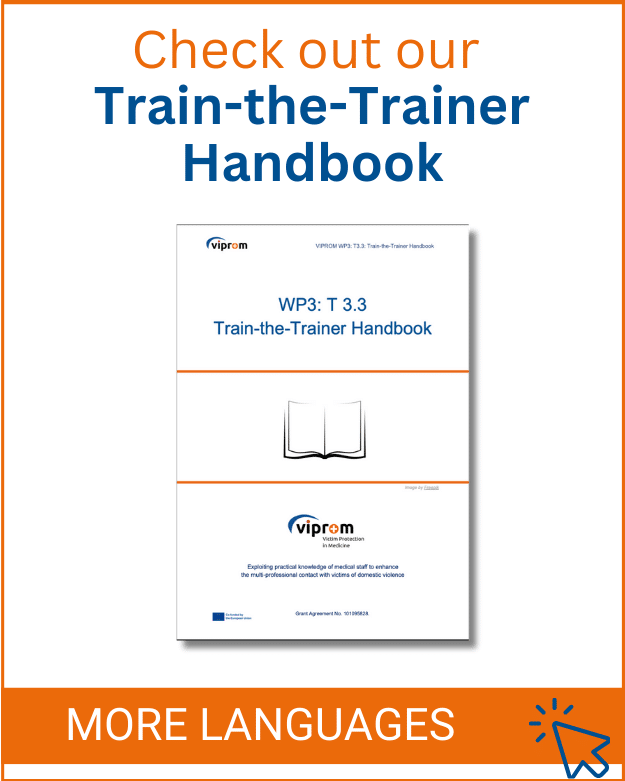
The VIPROM Train-the-Trainer Handbook
The VIPROM Train-the-Trainer Handbook is a cornerstone of the project’s capacity-building approach. It accompanies the VIPROM Train-the-Trainer programmes and provides trainers with detailed guidance on how to deliver high-quality, sustainable, and context-sensitive trainings on domestic violence. The handbook outlines the didactic principles, learning objectives, and training methods used within VIPROM. It supports trainers in adapting the curricula to different professional groups while maintaining core quality standards.
To ensure broad accessibility and long-term impact, the handbook is available in English, German, Italian, Swedish, and Greek, with a dedicated adaptation for the Austrian context. This multilingual approach allows medical institutions across Europe to implement VIPROM trainings in a way that is both standardised and locally relevant.

VIPROM – A CRADDLE FOR NEW CHANGEMAKERS
✔ We implemented and evaluated successfully a VIPROM train-the trainer programme
To facilitate capacity building and training new trainers as part of our changemaker programme, we developed a highly successful TtT curriculum and programme.

WHAT MAKES VIPROM A SUCCESS STORY?
A project is considered successful when it creates lasting structures, tools, and networks that continue to strengthen the medical response to domestic violence across Europe. For a dentist recognising signs of domestic violence for the first time, or a healthcare professional responding with confidence to a patient’s disclosure, VIPROM’s tools can make the difference between hesitation and action. These moments may never appear in statistics, yet they reflect the project’s real impact in daily medical practice. With trainings continuing beyond the official end of the project on 14 February, every trained professional, every disclosure, and every informed decision has the power to change lives.
Returning to the question posed at the beginning of this blog – whether VIPROM has grown from the promises of a project proposal into a true success story – the answer is clear.
VIPROM has indeed become a European success story, with an impact that extends far beyond the project’s duration! Its achievements are embedded in lasting structures, enhanced capacities, and everyday medical practice.
MORE INFORMATION ON DOMESTIC VIOLENCE
If you are interested to learn more about Domestic Violence in the health sector, please visit our European training platform on domestic violence.
FOOTNOTE
1. Ban Ki-moon, former Secretary-General of the United Nations
ABOUT THE AUTHORS

Prof. Dr. Dr. Bettina Pfleiderer PhD MD works as associate professor and head of the research group Cognition & Gender at the Clinic of Radiology of the medical faculty of the University Muenster in Germany. She is the coordinator of VIPROM and a known expert in the field of domestic violence and medical education since many years and is lecturing on domestic violence globally. She and her research team developed the EUROPEAN training platform on DV for the healthcare sector, police, and social sector (www.training.vimprodo.eu).

Madeleine Stöhr, M.A., works as a research assistant at the Clinic of Radiology and is a member of the coordinating team of the EU project VIPROM – Victim Protection in Medicine. She holds a Master’s degree in Human Rights from Central European University. She was closely involved in the development of the European training platform on domestic violence. Beyond her academic work, she is a passionate graphic designer who enjoys transforming complex ideas into clear and engaging visuals.
 This project has received co-funding from the European Union’s CERV-2022-DAPHNE programme under grant agreement No. 101095828.
Newsletter
Please subscribe here for the VIPROM newsletter: